
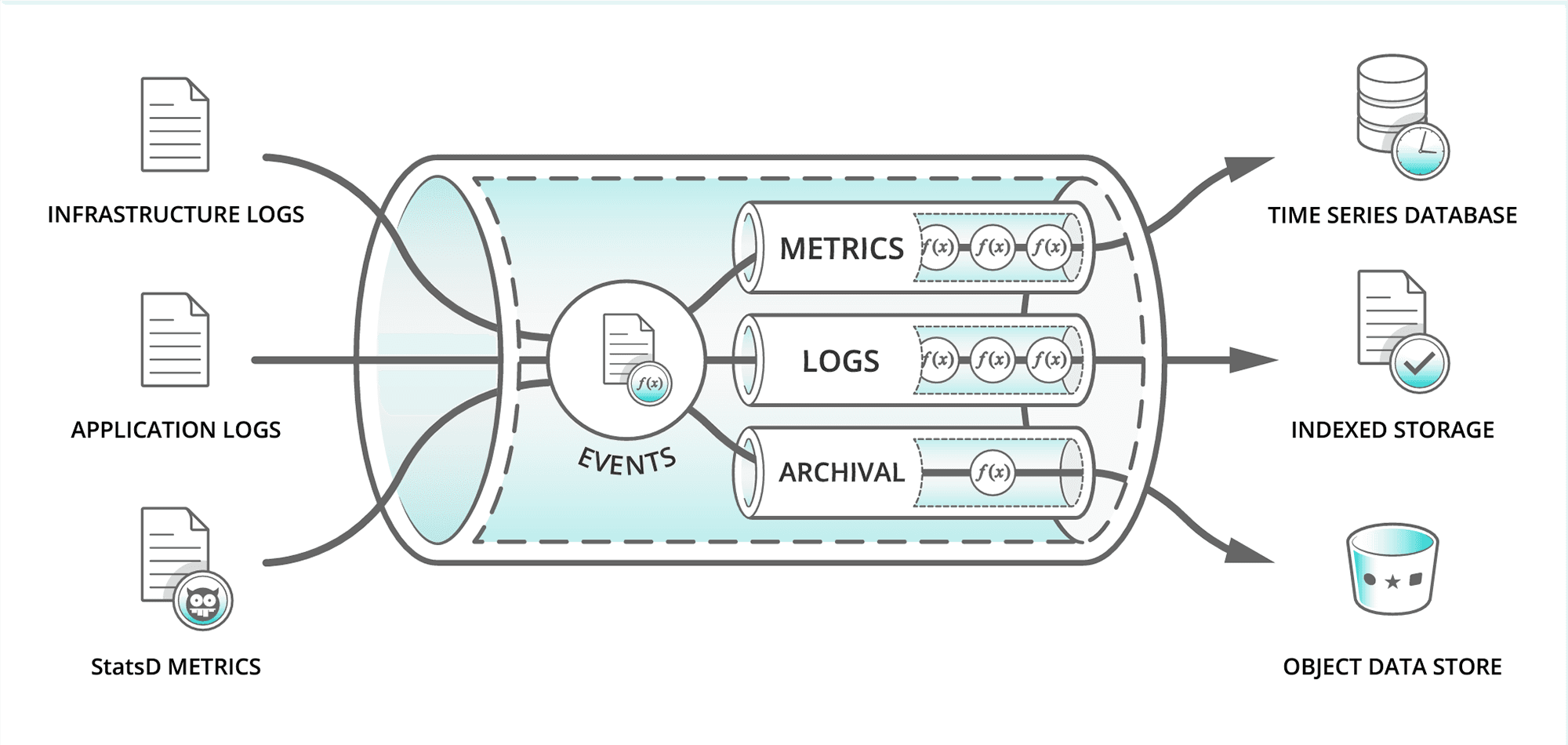
A data pipeline is a system that collects data from many sources, shapes it in flight, and sends it to one or more destinations. Think of it as a manifold for your machine data. Logs, metrics, traces, and events flow in from everywhere, get filtered, enriched, or redacted on the way through, and arrive in the analytics, security, and storage tools your teams already use. One data pipeline replaces a tangle of bespoke, point-to-point connections.
Telemetry volumes are growing close to 30% annually, according to Cribl's Architecture Design Guide, 2026, and every new tool has traditionally meant a new agent, a new format, and a new bill. A data pipeline breaks that cycle. It sits between your sources and your destinations so you can decide what to collect, how to process it, and where to send it.
Data pipelines are built using a combination of software tools, technologies, and coding scripts. Many companies offer data or observability pipelines. They share many common features like routing, filtering, and shaping, but each vendor also has some unique values. In addition to buying a data pipeline solution, some organizations may use open-source tools to build their own, either for cost-saving or to address specific issues in their enterprise. However, once it’s built, you have to maintain it forever, which might prove to be more expensive and complex than an off-the-shelf solution.
What does a data pipeline actually do?
A data pipeline performs three jobs on data in motion: it extracts data from a source, transforms it into a usable shape, and loads it into a destination. That follows the classic ETL lineage, but a modern data pipeline is broader. It handles unstructured machine data, runs in real time, and can fan a single stream out to many destinations at once. For a full breakdown, see our comparison of data pipelines versus ETL.
For IT and security teams, value appears while data is still in flight. As telemetry transits the pipeline, you can:
Add context by enriching events with information from external sources such as GeoIP databases, asset inventories, or threat intelligence feeds.
Protect sensitive data by redacting, masking, hashing, or encrypting fields before they leave your control.
Optimize volume by dropping noise, sampling high-frequency events, or converting verbose logs into compact metrics to meet cost and performance targets.
Who relies on this? Administrators, managers, and everyday users of operational, DevOps, and security intelligence products. If you own a SIEM, an observability platform, or a data lake, you already depend on a data pipeline whether you call it that or not.
Should you build or buy a data pipeline?
Many vendors offer data pipelines or observability pipelines. They share core features like routing, filtering, and shaping, and each brings its own strengths. Some organizations build their own from open-source components to save money or solve a narrow problem.
Once you build it, you maintain it forever. Patching, scaling, upgrades, schema drift, and 3 a.m. pages all land on your team. That long tail often costs more in people and infrastructure than an off-the-shelf pipeline, and it pulls engineers away from the work that moves the business.
What are the types of data pipelines?
Data pipelines fall into three processing models and two deployment modes. Matching the right type to the right workload is the difference between a pipeline that hums and one that hemorrhages budget.
Batch processing pipelines
Batch pipelines process large volumes of data at scheduled intervals. They excel when you do not need real-time answers, such as nightly reporting, compliance archives, or historical backfills. Moving data in bulk makes efficient use of compute and storage.
Streaming data pipelines
Streaming pipelines process data the moment it arrives. They power use cases where seconds matter: fraud detection, security alerting, and live performance monitoring. Processing on arrival lets teams act while the event is still unfolding.
Hybrid data pipelines
Most mature pipelines do both. A hybrid pipeline streams high-priority signals to real-time tools while sending lower-priority or full-fidelity data to batch processing and long-term storage. That flexibility gives you immediate insight and full analysis without running two separate systems.
Deployment modes
Data pipelines are available as cloud (SaaS) offerings, self-managed software for on-premises environments, or hybrid combinations of both. The right fit depends on where your sources and destinations live, your security and compliance posture, and how much infrastructure you want to run yourself.
What are the benefits of a data pipeline?
A well-designed data pipeline pays off in operational efficiency, data quality, and faster business decisions. Here is what that looks like in practice.
What does data pipeline architecture look like?
Data pipeline architecture varies with the complexity of your environment, but most pipelines share six building blocks. Understanding each one helps you spot where reliability, cost, or governance can slip.
Data source
Sources are where raw data originates: databases, files, web APIs, cloud services, agents, and message buses. Before you can ingest anything, you attach a source to the pipeline. Source diversity is usually the first challenge, since every system speaks its own format and protocol.
Agent or extractor
The agent sits outside the pipeline, either on the source itself or between the source and the pipeline. Its job is to collect data efficiently and hand it off. Consolidating agents is one of the fastest ways to reduce endpoint overhead and shrink your attack surface.
Pre-processing or transformer
This is the first stop once raw data enters the pipeline. Events are parsed, cleaned, and normalized into a more usable shape. Careful preparation here sets up accuracy and consistency for everything downstream.
Routes
Routes decide where each event goes next. A set of filters identifies a subset of incoming events and sends them to a specific processing path. Routes let you send the same data to multiple destinations, each with its own treatment.
Processor: pipelines and functions
Data matched by a route flows into a logical pipeline, the heart of processing. A pipeline is a series of functions, and a function is simply code that executes on an event. Processing can mean string replacement, obfuscation, encryption, event-to-metric conversion, and more.
For example, a pipeline might chain three functions: one replaces the term "foo" with "bar," the next hashes "bar," and the last adds a field such as dc=jfk-42 to any event matching source=='us-nyc-application.log'. Small, composable steps add up to precise control.
Destinations
The final stage forwards processed data to where it will be used or kept: analytics platforms, SIEMs, data lakes, object storage, or any combination. A good pipeline shapes data to match each destination's expected schema so tools work well from day one.
Where are data pipelines headed?
By 2030, data pipelines will decouple telemetry collection from analysis entirely. Today, adopting a new visualization tool or sharing telemetry across teams often means swapping or duplicating agents. Tomorrow, a single agent will power multiple experiences without reconfiguration, driven by wider adoption of OpenTelemetry and the OTLP protocol.
Translation between formats will become routine. Converting logs to metrics or traces to metrics inside the pipeline lets teams analyze, visualize, and correlate telemetry across tools without custom glue code. That change breaks down barriers between IT and security stacks and gives both teams unified, adaptable pipelines.
Decoupling agents from platforms is the linchpin. When agents are no longer welded to a single vendor's backend, you gain freedom to evaluate, migrate, and innovate. The result is a future where data pipeline tools adapt to the needs of your business.
Collect once, route anywhere, keep your options open
Data pipelines are central to modern IT and security operations, and Cribl is built to make them work for you rather than for a vendor. At the core is the Data Engine for IT and Security, a vendor-agnostic hub that collects telemetry once and gives you choice and control over where it goes.
Cribl Stream acts as a universal receiver, ingesting logs, metrics, traces, and events from any source regardless of format or protocol, then normalizing that data so it works with every tool in your stack. Because Stream routes a single collected stream to multiple destinations simultaneously, IT, security, and operations teams can share data without duplicating agents or configurations. Whether you are landing data in AWS, Azure, GCP, or on-premises storage, you send only the high-value subset to expensive analytics platforms and keep the rest in low-cost storage, replayable whenever you need it.
The rest of Cribl's suite extends the pipeline in both directions. Cribl Edge brings collection and lightweight processing to the endpoint so you can consolidate agents and shape data before it leaves the host. Cribl Lake provides tiered, open-format storage for full-fidelity telemetry, and Cribl Search lets humans and AI agents query data where it lives through federated search, with no rehydration required.
Trusted by half of the Fortune 100, Cribl helps enterprises reduce telemetry volume, accelerate SIEM migrations, and stay compliant without adding agents or disrupting existing systems. Your data pipeline should serve your teams, not lock them in. With Cribl, it does.
Data Pipelines FAQ
What is meant by a data pipeline?
A data pipeline is a series of processes that moves telemetry data from a source to a destination while transforming, enriching, or organizing it along the way. It ensures seamless data flow for analysis, visualization, or storage.
What is an example of a data pipeline?
An example is a telemetry pipeline that collects user activity logs from a website, processes them in real time to generate metrics, and sends the insights to a dashboard for monitoring for user experience.
Is a data pipeline an ETL?
Not necessarily. ETL (Extract, Transform, Load) is a type of data pipeline focused on structured data workflows. Data pipelines encompass broader use cases, including real-time processing, data routing, and telemetry management. Learn more about the differences between both and which is best for your data strategy here.
What are the main 3 stages in a data pipeline?
Ingestion: Collecting raw data from sources.
Processing: Transforming, enriching, or organizing data.
Delivery: Sending processed telemetry data to its final destination, such as storage or visualization platforms.